
.:Film criticism by aesthetes for connoisseurs:.
| :: To search Sunset Blvd, use the Blogger bar at the top of the page :: |
| [::..resources..::] |
| :: imdb |
| :: box office mojo |
| :: foreign films |
| :: turner classic movies |
| :: british film institute |
| :: american film institute |
| :: culture vulture |
| :: screenwriter's utopia |
| :: screenplays |
| :: movie physics |
| :: auteur |
| :: the macguffin |
| :: strictly film school |
| [::..critics..::] |
| :: ebert |
| :: metacritic |
| :: rotten tomatoes |
| :: milk plus |
| [::..archives..::] |
:: 1.20.2005 ::
Build My Gallows High, Baby
It is fitting that so many of the best films exploring themes of moral ambiguity were shot in black, white, and shades of gray. I'm referring to film noir, of course; in particular, that shadowy, smoky masterpiece of American noir, Out of the Past (1947), directed by Jacques Tourneur.
Robert Mitchum, lazy-voiced, sleepy-eyed, and charismatic as always, plays Jeff Bailey, a secretive loner trying to start over in a small town in the Sierras. But as luck—bad luck—would have it, a gangster named Joe Stephanos (Paul Valentine) blows through town one day and happens to spot Jeff going about his business. Affable yet sinister, Joe convinces Jeff to go up to Lake Tahoe to meet with his boss, Whit Sterling (Kirk Douglas), a man who apparently has an old score to settle.
As he drives all night to Tahoe, Jeff recalls the sordid details of the past he has tried to forget. Three years earlier, he worked as a slouching, smoking detective in New York, and Sterling hired him to track down his lover, a woman he claims shot him, left him for dead, and ran off with $40,000. "I just want her back," Sterling explains. "When you see her, you'll understand better."
Jeff manages to trace the woman, named Kathie Moffat (Jane Greer), to Mexico. "You say to yourself, How hot can it get? Then, in Acapulco, you find out," Jeff says, as he describes how he found Kathie, the mysterious beauty hiding a heart of black sin. Jeff falls for her, and their love scenes are somehow convincing, despite ominous signs that things can only end badly. The following exchange takes place as they stand by a roulette wheel:Jeff: That isn't the way to play it.Jeff ignores his own warning and gambles everything on Kathie, and they go on the run together. Kathie's protestations of innocence in the theft of Sterling's money are somehow convincing, too—she really does have the face of an angel—but when she abandons Jeff after killing the man Sterling sends after them, he finally learns the ugly truth about her.
Kathie: Why not?
Jeff: 'Cause it isn't the way to win.
Kathie: Is there a way to win?
Jeff: Well, there's a way to lose more slowly.
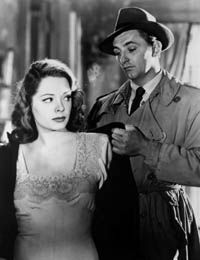
That's where the flashback ends. Unsurprisingly, when Jeff arrives at Sterling's lodge, he finds Kathie there. She wastes no time getting Jeff, now weary and bitingly cynical, alone:Kathie: I had to come back. What else could I do?Kathie really can't seem to help any of the wicked things she does—but that doesn't make them any less wicked. And Jeff doesn't actually seem to care about doing the right thing—but he brings Kathie to justice anyway, destroying himself in the process. Film noir is pessimistic and fatalistic, but never nihilistic. Even in a meaningless universe, one can't escape the law of cause and effect. The past catches up with everyone.
Jeff: You can never help anything, can you? You're like a leaf that the wind blows from one gutter to another. You can't help anything you do, even murder.
Kathie: You can't say it was that.
Jeff: I can say one thing. I buried him.
:: Posted by Laurie @ 11:21 PM [+] ::
...
